Intent Tracking for GEO: How to Measure Your Brand's Visibility in AI Search
Learn what a GEO intent is and how to track one in five steps, with real data from Fra Diavolo.
.png)
AI search has no demand data. Nobody outside the platforms can see what buyers ask or how often. Every visibility number is therefore an estimate built from a sample of questions, and the sample decides what you see. Building that sample around intents, rather than a list of prompts, turns scattered spot checks into a reliable view of where the brand stands.
AI search offers no equivalent of keyword data, so brands can only see their visibility through samples. The intent, defined by persona, need and stage, is the right sampling unit, because it represents a market territory rather than a string of words. Real tracking data from Fra Diavolo shows why position and coverage must be measured separately. It also shows growing coverage taking the brand from invisible to second place across the intents it tracks.
Generative answers are not deterministic, and small changes in wording change the sources an engine retrieves. A single prompt therefore measures noise as much as signal. Intent-based tracking defines a need by persona, object and stage, then samples it through multiple phrasings across engines and runs. It aggregates the results into an estimated probability of being named.
AI platforms do not share what people ask them. There is no Search Console for AI search. So AI visibility cannot be measured directly. It has to be sampled, by simulating the questions real buyers would ask. The right unit to sample is the intent. It is a buying need, defined by who is asking, what they want and their stage of decision. Each intent is sampled through many phrasings, because AI answers change with the wording and from one run to the next. Being named is only half the job. The other half is making sure AI describes the brand correctly.
Choosing what to track is a strategic decision, not an operational one. The intents a brand samples decide which markets it sees, which competitors it is compared against and which gaps it acts on. A good portfolio covers territories to defend, to expand into and to conquer.
Ask an AI assistant which pizzeria to book in Rome, and you won't get a list of links. You'll get one written answer that names a handful of places.
Now try to find out how often your brand appears in answers like that. You can't. The AI platforms don't share what people ask them, and no two people ask in quite the same way.
So AI visibility can't be measured directly. It has to be sampled, by simulating the questions real buyers would ask. How you build that sample decides what you see.
The right unit to build it from is the intent.
This guide covers what an intent is, why it matters, and a five-step method for tracking one. Every step uses real data from our client Fra Diavolo, an Italian restaurant group. In six months, it went from invisible in AI answers to second place across the intents it tracks.
What is an intent in GEO?
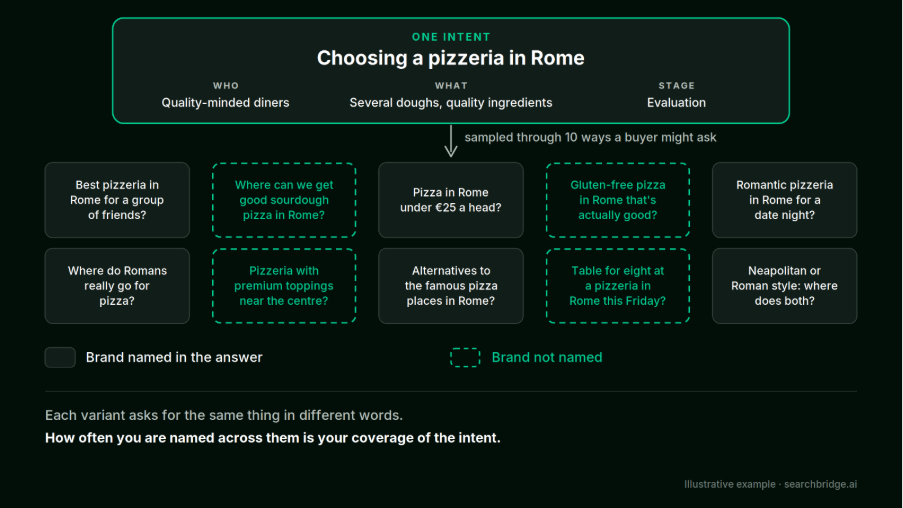
An intent is a buying need, defined by three things: who is asking, what they are looking for, and where they are in their decision. It is the unit you track in AI search.
A prompt is just one way of putting that need into words. Track prompts one by one and you are measuring wording. Track intents and you are measuring the market.
Fra Diavolo shows what this looks like in practice. It does not track "pizza". It tracks four intents, one for each city where it competes: Milan, Rome, Turin and Bologna. Each describes the same kind of buyer, at the same stage, in a different market.
Why do intents matter now?
Nobody can see what people ask AI. In search, Search Console shows real queries and keyword tools estimate demand. AI platforms publish nothing comparable, so any "prompt volume" figure is an indirect estimate. People also ask differently. iPullRank's December 2025 analysis put the average AI prompt at 70 to 80 words, against three or four for a search. They describe situations, not keywords.
One question becomes many searches. An industry analysis by Nectiv, reported by Similarweb, found that Google's AI Mode typically runs five to eleven sub-queries for a single prompt. Google's own launch announcement in May 2025 said its Deep Search mode can run hundreds.
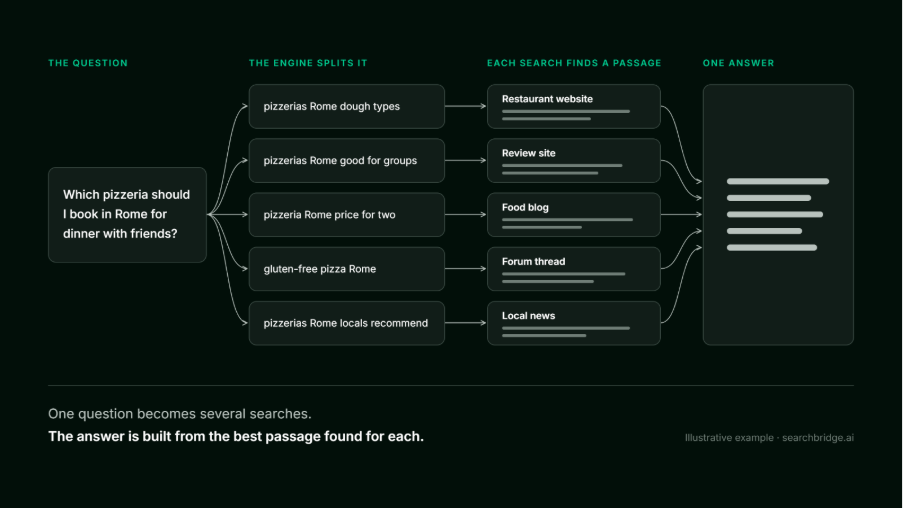
That makes answers sensitive to wording. Ask the same thing two ways and the AI engine may search differently, draw on different sources and name different brands. Answers also vary from one run to the next. A single prompt is one noisy reading. An intent, sampled many times, gives you a reliable one.
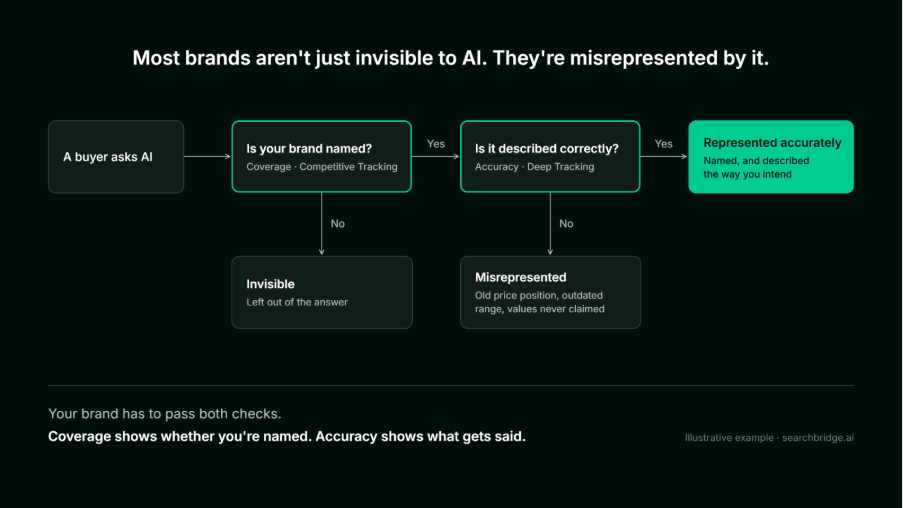
Being named is not the same as being described correctly. AI can include your brand and still get the details wrong: an old price position, an outdated range, values you never claimed. Intent tracking helps you find these gaps and decide where to focus.
How to track an intent in five steps
- Choose where you want to win
- Define each intent: who, what and which stage
- Sample it through many phrasings
- Measure coverage and position separately
- Act on the gaps, then measure again
We'll use Fra Diavolo's data to illustrate each step.
1. Choose where you want to win
Start with strategy, not prompts. The intents you track decide which markets you see and which competitors you are measured against. If the strategy isn't explicit, the sample will set it for you.
Francesco Mura, Head of Strategy at Search Bridge, frames the answer as three kinds of territory:
- Defend: where the brand is strong today. Track it to spot errors early.
- Expand: adjacent territory where the brand is partly present. Track it to measure growth.
- Conquer: where the brand wants to be in the long term. Track it to set a baseline.
Fra Diavolo tracks four intents, one per city. The same offer faces different rivals in Milan than in Bologna, so each city is its own territory.
2. Define each intent: who, what and which stage
A good intent answers three questions:
- Who is asking? The same need gets different answers for different people.
- What are they looking for? This defines the territory, and so the competitors that matter.
- Which stage are they at? Exploring the problem, evaluating options, or deciding.
Fra Diavolo's Rome intent reads like this.
Who: diners who care about food quality, from groups of friends to couples.
What: a pizzeria with several dough types and quality ingredients.
Stage: evaluation. They have decided on pizza and are comparing places.
Use a quick test. Could someone be in this situation without knowing your brand exists?
Leave your brand name out. In the Search Bridge methodology, questions never name the brand being measured. Naming it makes AI more likely to mention it, which skews the result.
3. Sample it through many phrasings
Real buyers describe the same need in many different ways. So each intent is sampled through several variants: as a problem, as a request for advice, with a budget, or as a search for alternatives.
In the Search Bridge platform, every intent is sampled through 10 variants. Each one runs on every AI engine you track. Here are two of the ten for Fra Diavolo's Rome intent, exactly as the platform wrote them:
"I'm a foodie (28) visiting Rome and obsessed with trying different doughs and premium toppings — what pizzerias would you recommend for an unforgettable dinner?"
"Honestly I'm tired of the usual thin-crust spots, in Rome now and want real variety in dough and high-quality ingredients — what would you recommend instead?"
Both express the same need. The first comes from a food lover, the second from someone looking for alternatives. Neither names a brand.
This is what makes the measure stable. One prompt gives one answer, and the next run may differ. Ten variants across several engines let you estimate how often the brand is named when that need comes up. A list of separate prompts can't do that, because it treats every wording as its own result.
4. Measure coverage and position separately
For each intent, track two numbers:
- Coverage: in how many of the answers you are named.
- Position: when you are named, how high on the list you appear.
Here is Fra Diavolo on the latest tracking run. Each intent's 10 variants run on three AI engines: Perplexity, OpenAI and Google Gemini. That makes 30 answers per city.
Share of AI Visibility, also called share of voice, is the brand's position-weighted share of all the brands named across those answers. For more definitions, see the GEO and AI search glossary.
When Fra Diavolo is named, it usually sits near the top of the list. Across its four intents and three engines, it is now the second most visible brand of all those named.
Rome makes the point best. When Fra Diavolo is named there, it already sits higher on the list than the city's leader. Its average position is 1.8, against the leader's 2.6. The leader is ahead because it is named in more answers, 19 of 30 against 6. Fra Diavolo already has the position. What Rome needs is coverage.
5. Act on the gaps, then measure again
Use the gaps to decide what to do next. Depending on what the data shows, that may be content, PR, partnerships or technical fixes. Then measure again, and check both halves. Did your coverage grow? And did AI's description of your brand improve with it? Measuring over time is also how you see progress.
The takeaway
Search engines ranked results for a keyword. AI engines decide what your brand is, then decide whether to name it. The first is a ranking problem. The second is a representation problem. You can't see it one prompt at a time. You see it by tracking intents, sampled well enough to trust.
Featured articles

.png)
.png)
_2026-08-19_08-21-44.png)
.jpg)
Join the brands AI recommends first
Teach AI how to sell your products, so LLMs can recommend you with confidence.
Frequently asked questions
You have questions, we have answers.
What is Search Bridge?
What if my brand is invisible or misrepresented in AI answers?
What AI engines do you track?
How is it different from traditional SEO or paid media?
How is Search Bridge different from other GEO platforms?
Who is Search Bridge best for?
What implementation readiness is required?
Featured in


.svg)
.svg)
.svg)